Guides/Buying guides·10 min read·Updated September 4, 2026
A category-by-category comparison of the permanent lighting options available to Canadian homeowners: professional-install brands, consumer smart strips, and DIY roofline kits, with what each actually costs and where each one fits.
Key takeaways
- 1Trimlight, Jellyfish and Gemstone are professional-install franchise brands; the hardware differs by brand but a licensed installer typically charges $25 to $40 per foot installed.
- 2Consumer smart strips like Govee and Eufy are adhesive-mounted, run $2 to $4 per foot, and are meant for shorter runs or accent use rather than a full roofline.
- 3DIY 12V kits from Permanent Lighting Direct use the same category of hardware as the professional brands, aluminum track, RGBW pucks, WiFi app control, at a kit-only price with no install labour.
- 4The real trade-off is not light quality, it is who does the mounting: a franchise installer, yourself with basic tools, or an adhesive strip you stick up in an afternoon.
- 5RGBW pucks with a dedicated white channel, used in the professional brands and in our kits, produce a cleaner warm white than RGB-only strips that mix colours to fake white.
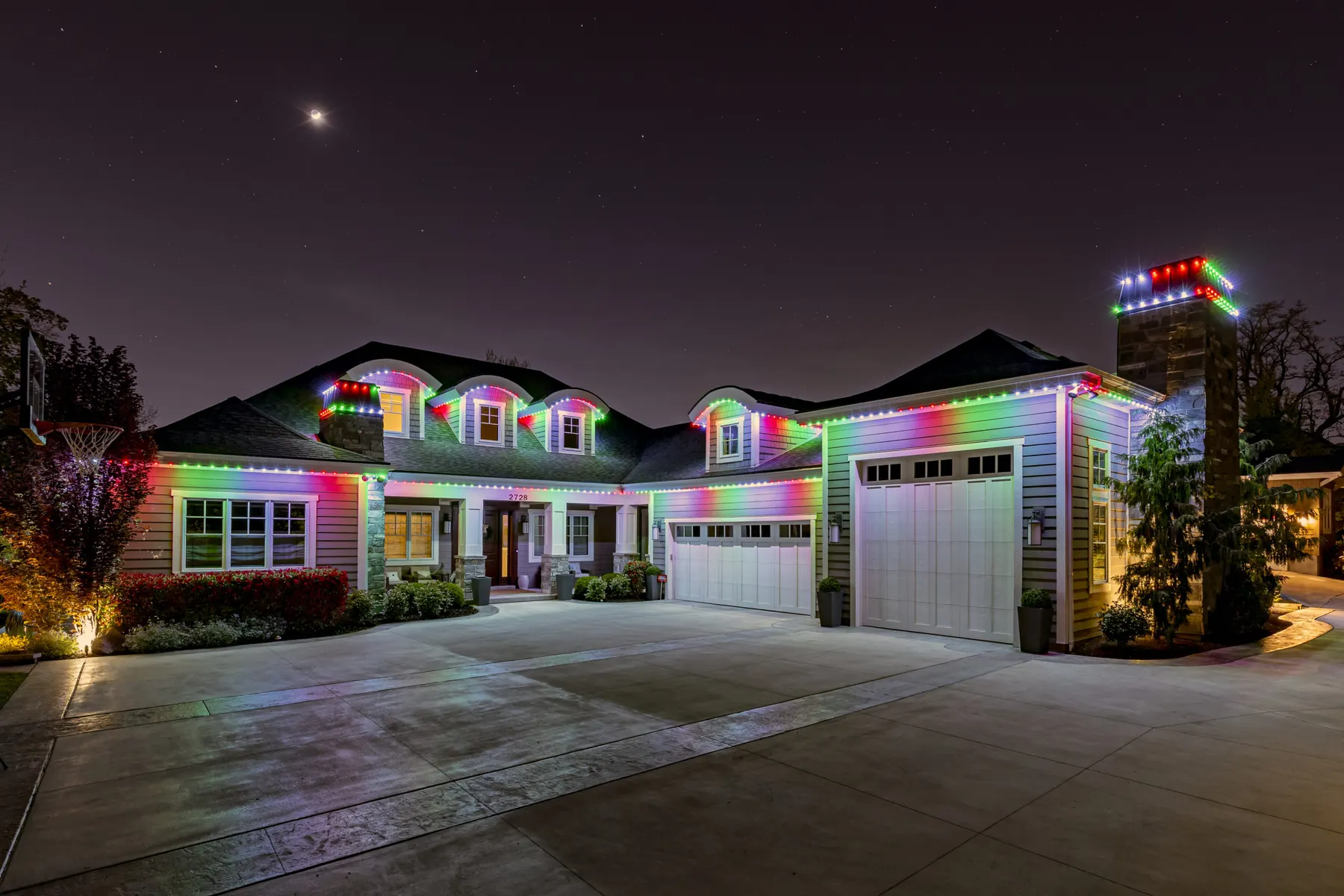
Permanent roofline lighting has gone from a niche product to something most Canadian homeowners have seen on a neighbour's house, usually a smooth line of colour along the eaves that flips between a subtle warm glow on a weeknight and full colour for a holiday or a game. The confusing part for anyone shopping is that the options come from three very different corners of the market: franchise install companies, consumer smart-home brands, and DIY parts suppliers. They can look similar in a photo and cost wildly different amounts. Here is how they actually compare.
The professional-install category: Trimlight, Jellyfish, Gemstone
Trimlight, Jellyfish Lighting and Gemstone Lighting are the three names most homeowners run into when they search for permanent lighting in Canada. All three operate on a dealer or franchise model: a local installer buys into the brand, and homeowners book that installer to measure the house, supply the hardware and mount it. The hardware across these brands is broadly similar in concept, low-voltage RGBW pucks in an aluminum or channel track, controlled by an app, though each brand has its own proprietary controller and its own track profile, which means parts are not interchangeable between brands and you are tied to that installer for future service.
The appeal is straightforward: someone else measures, orders, climbs the ladder and wires it up, and you get a finished product with a workmanship warranty from the installer. The cost reflects that. Professional installs in Canada typically run $25 to $40 per linear foot installed, which puts a modest bungalow eave in the $3,000 to $6,000 range and a larger two-storey home with gables well past that.
What you are actually paying for
That per-foot price covers the hardware, the labour, the ladder work and liability, and usually a service visit or two if something needs adjusting. It is a reasonable amount to pay for a fully hands-off experience, particularly on a tall or complex roofline where a homeowner would need a scaffold or would rather not be on a ladder at all. It is worth knowing, though, that the underlying hardware category, sealed low-voltage RGBW pucks in aluminum track with app control, is not exclusive to these franchises. It is the same category of product available directly as a kit.
The consumer smart-lighting category: Govee, Eufy and similar
Govee, Eufy and a handful of similar brands sell permanent-style outdoor light strips through big box retailers and online, generally priced around $2 to $4 per foot. These are adhesive-mounted strips, not screwed-down track, and they connect to an outdoor-rated controller over WiFi or Bluetooth with an app that offers a wide range of colour scenes and music sync effects.
The lower price comes with real trade-offs. Adhesive mounting works well on a clean, dry surface for a season or two but is less certain as a permanent, multi-year fixture through freeze-thaw cycles, and the wiring typically runs exposed along the surface rather than concealed in a rigid channel, which shows in daylight more than a track-mounted system. Most of these strips are also RGB rather than RGBW, meaning there is no dedicated white diode, so the white light is mixed from the red, green and blue channels and tends to read slightly blue or pink rather than a true warm white. For a shorter accent run, a porch, a window frame, a tree, this category is a reasonable and inexpensive option. For a full roofline meant to look clean in daylight and hold up for years, it is a step down from track-based systems.
The DIY kit category: where Permanent Lighting Direct fits
DIY kits sit in between, using the same style of hardware as the professional franchises, aluminum track, sealed RGBW pucks, a WiFi WLED-based controller, a dedicated 12V power supply, but sold as a kit you install yourself rather than bundled with installation labour. Our 100 ft kit, for example, includes 32 strands of 5 RGBW pucks, 31 pieces of 42-inch 5-hole aluminum track in your choice of black, white, wicker or brown, one WiFi controller with 16 million colours plus a dedicated warm white channel, a 150 W power supply, and the full set of connectors, power-injection cables and colour-matched soffit screws needed to finish the run.
- 50 ft kit: $1,265
- 75 ft kit: $1,485
- 100 ft kit: $1,729.20
- 150 ft kit: $2,240.70
- 200 ft kit: $2,648.80
- 250 ft kit: $3,157
Against a $25 to $40 per foot installed price from a franchise, a comparable DIY kit at roughly $13 to $22 per foot in materials makes the maths straightforward for anyone reasonably comfortable on a ladder for a weekend. The pucks in our kits carry the same specifications you would expect from a professional-grade system, roughly 46 lumens and 0.3 W each, a 50,000-hour rating, IP68 sealing, tested to -40 C, and built to CSA Class 2 low-voltage standards, all backed by a 5-year parts warranty.
Comparing the categories side by side
- Franchise install (Trimlight, Jellyfish, Gemstone): $25-40 per foot installed, hands-off, proprietary hardware tied to one installer.
- Consumer smart strips (Govee, Eufy): $2-4 per foot, adhesive mount, visible wiring, mostly RGB rather than RGBW, best for shorter accent runs.
- DIY 12V kits (Permanent Lighting Direct): roughly $13-22 per foot in materials, self-installed in a weekend, RGBW with dedicated warm white, aluminum track, standard connectors, 5-year warranty.
Warranty and long-term ownership
Warranty terms are worth comparing as closely as price, since permanent lighting is a multi-year purchase either way. Franchise brands generally back their installs with a workmanship warranty from the local dealer, which is only as durable as that dealer staying in business and continuing to operate in your area; if a franchisee closes or the territory changes hands, getting warranty service can become more complicated. DIY kits carry a manufacturer parts warranty instead, five years in the case of our kits, which follows the product rather than a specific local business. Neither approach is wrong, but it is worth asking a franchise installer directly what happens to your warranty if they stop operating, since it is a real scenario in a growing industry with a lot of new dealers.
Serviceability and future changes
Houses change. A homeowner adds a sunroom, builds a fence with a gable end worth lighting, or simply wants to extend an existing run to the garage a couple of years after the original install. With a franchise system, that means calling the same installer back, since the track and controller are proprietary to that brand and are not something another company can service or extend using off-the-shelf parts. With a kit built on standard aluminum track, extension connectors and T-connectors, extending a run later is straightforward with the same tools used for the original install, and it does not depend on one specific company remaining available or willing to take on a small add-on job. This is a genuine advantage for homeowners who expect to be in the house for years and may want to adjust the layout down the road.
What none of these options change
Regardless of which category a homeowner chooses, the fundamentals of a good permanent lighting install do not change. The track needs to be fastened into solid material, every connector needs to be fully seated, long runs need power injection planned in from the start, and the controller needs a stable WiFi connection to work reliably. A franchise installer handles all of that as part of the service; a DIY kit puts it in the homeowner's hands, which is exactly why our install guide at /diy-kits walks through each of those steps in the order they actually happen on a ladder, not just as a parts list.
Which one actually fits your house
If the budget supports it and the roofline is tall, steep or otherwise not something you want to climb, a franchise install buys convenience and a workmanship guarantee, and that is a legitimate reason to pay more. If you want a short, low-commitment accent on a porch or a tree, a consumer strip is an inexpensive way to try the look before investing further. If you want the full roofline look with professional-grade hardware, RGBW colour, a track-mounted finish, and you are willing to spend a weekend with a drill and a ladder, a DIY kit gets there for a fraction of the installed price and leaves you owning parts that are easy to extend later rather than locked to one brand's proprietary system.
Getting started with a DIY kit
Measuring the roofline correctly is the first step regardless of which category you choose, since it determines kit size, connector count and whether you need power injection on a long run. Our step-by-step install guide, linked at /diy-kits, walks through planning the run, mounting the track and setting up the app, and the full lineup of kit sizes and pricing is available at /shop. For a deeper look at how the system components fit together, see /how-it-works.
Frequently asked questions
Is Trimlight or Jellyfish better than a DIY permanent lighting kit?
The underlying hardware category, low-voltage RGBW pucks in aluminum track with app control, is similar across professional brands and DIY kits. The real difference is that franchise brands include installation labour and a proprietary controller tied to that company, at $25-40 per foot installed, while a DIY kit is the same style of hardware sold as materials only, at a fraction of the per-foot cost, for homeowners willing to install it themselves.
Are Govee or Eufy lights as good as a track-mounted permanent system?
They serve a different purpose. Govee and Eufy strips are adhesive-mounted and priced for shorter accent runs, generally $2-4 per foot, and most are RGB rather than RGBW, so whites can read slightly blue or pink. Track-mounted RGBW systems, whether professionally installed or a DIY kit, are built for a full roofline with concealed wiring and a true warm white channel.
How much does a full roofline of permanent lights cost installed by a professional?
Professional installs from brands like Trimlight, Jellyfish and Gemstone typically run $25 to $40 per linear foot in Canada, which puts an average bungalow around $3,000 to $6,000 and larger homes higher, depending on roofline length and complexity.
Can I install a DIY kit myself even if I have never done outdoor electrical work?
Yes, for a standard install. The system runs on 12V and the power supply plugs into an existing outdoor GFCI outlet, so there is no house wiring involved. Most homeowners with basic tools and a weekend can complete a single-storey front in an afternoon and a full two-storey home in a weekend with a helper.
What is the practical price difference between a DIY kit and a professional install for a 100 ft roofline?
A 100 ft DIY kit runs $1,729.20 in materials, while a professional install of a similar length at $25-40 per foot installed would run roughly $2,500 to $4,000, with the difference reflecting labour, proprietary hardware and a service warranty rather than a difference in the underlying light quality.
Can a franchise-branded system and a DIY kit use the same replacement parts?
No. Each franchise brand uses its own proprietary track profile and controller, so parts are not interchangeable between brands or with independent kits. A DIY kit built on standard connectors and track, like ours, is easier to extend or repair yourself down the road without being tied to one company.
Ready to build it?
Everything in this guide ships from London, Ontario.
Complete 12V kits from $1,265, plus every part sold separately. Free Canadian shipping over $500.
Keep reading
Buying guides · 9 min
Permanent Lighting Cost in Canada: DIY Kit vs Professional Install
Professional permanent lighting installs in Canada run $25 to $40 a foot. A DIY kit for the same house is roughly a third of that. Here is what the price difference actually buys.
Buying guides · 9 min
Permanent vs Seasonal Christmas Lights: Which Is Right for Your Home?
Seasonal strings, adhesive strip lights and permanent roofline systems all light up a house, but they cost, install and hold up differently. Here is how the three actually compare for a Canadian home.
Buying guides · 8 min
Choosing a Track Colour to Match Your Soffit: Black, White, Wicker or Brown
The aluminum track that carries a permanent lighting kit comes in four colours. Matching it to your fascia is the difference between a system that vanishes by day and one that draws attention for the wrong reasons.