Guides/Buying guides·9 min read·Updated September 4, 2026
Professional permanent lighting installs in Canada run $25 to $40 a foot. A DIY kit for the same house is roughly a third of that. Here is what the price difference actually buys.
Key takeaways
- 1Professional permanent lighting installs typically cost $25 to $40 per foot in Canada, largely for labour, not parts.
- 2A 100 ft DIY kit costs $1,729.20, or about $17.30 per foot, roughly a third of a typical installed price for the same run.
- 3Consumer strip lights like Govee or Eufy are cheaper per foot again, but they are adhesive-mounted, show visible wire, and are not built for permanent year-round exposure.
- 4The parts inside a DIY kit and a professional install are usually the same 12V aluminum-track system; the price gap is who does the mounting and wiring.
- 5A weekend of DIY labour is the trade-off for the savings, and the same 5-year parts warranty applies either way.
Anyone shopping for permanent LED roofline lighting in Canada runs into three very different price points within the first few search results: a few hundred dollars for consumer strip lights, a few thousand for a DIY kit, and sometimes double that for a professional install of the same size house. It is not obvious at first why the same idea, lights that stay on the house year round and change colour from an app, spans such a wide range. The short answer is that the parts are similar across DIY and professional options; the difference is almost entirely labour. This guide breaks down the real numbers so you can decide which route fits your budget and your Saturday.
What a professional install actually costs
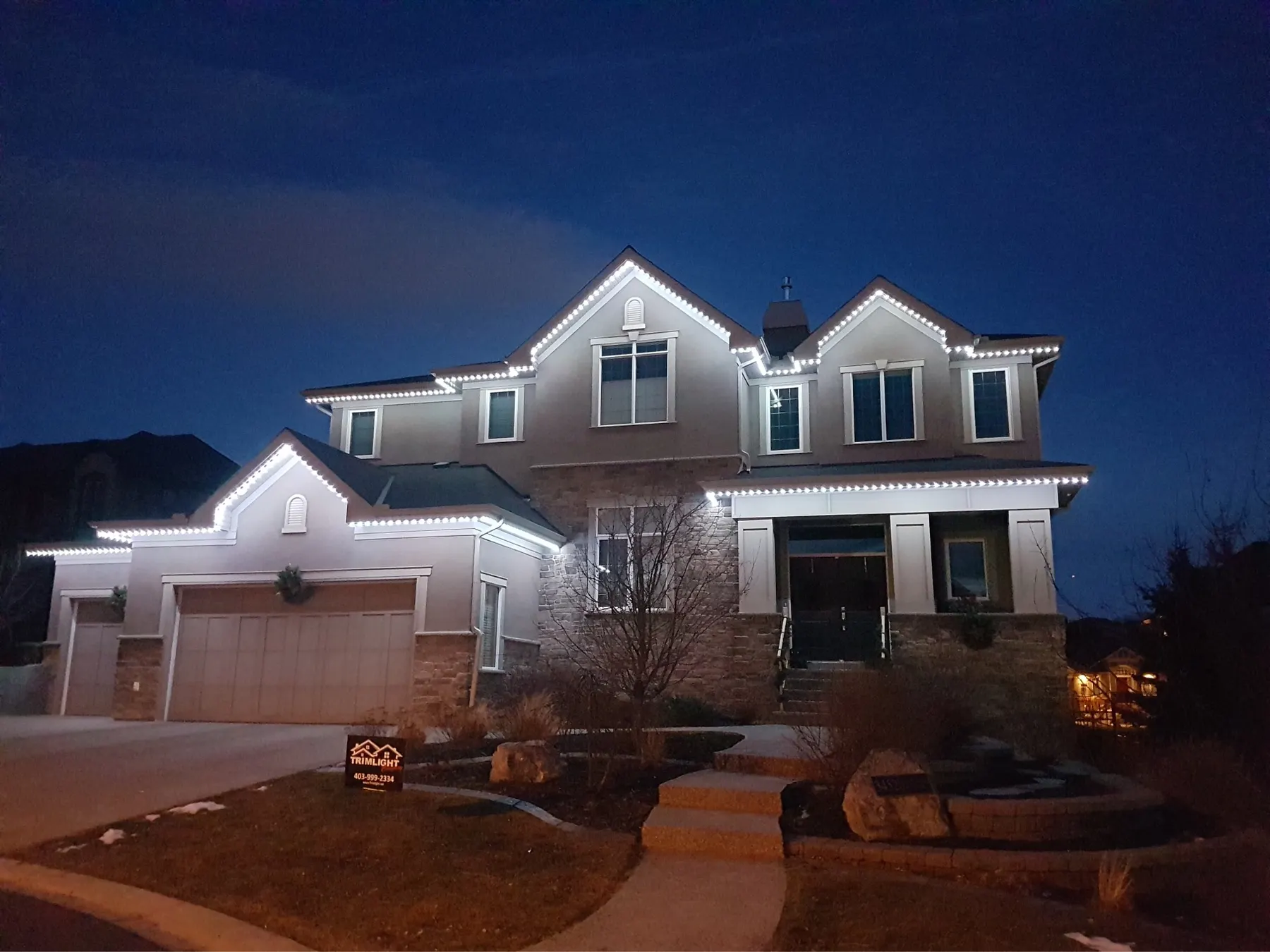
Professional permanent lighting installers in Canada generally price a job at $25 to $40 per linear foot, all in. For a typical suburban home with 100 ft of roofline to light, that puts a professional install somewhere between $2,500 and $4,000. Larger homes with multiple gables, dormers or a wraparound porch push toward the higher end of that range, both because there is more track to mount and because the corners and branches take longer to wire cleanly.
That per-foot rate covers more than just screwing track to the fascia. A professional crew typically handles the full roofline assessment, ladder work and fall protection for two-storey sections, precise cutting and fitting at corners and gables, running and hiding low-voltage wiring, mounting the power supply and controller, and a final walkthrough to confirm every section works and the app is configured. For homeowners who are not comfortable on a ladder, do not have a free weekend, or want the job done and warrantied by someone else, that price buys real convenience.
What a DIY kit costs
A DIY permanent lighting kit is priced by length, with everything needed for the install bundled in. Current kit pricing in Canadian dollars runs as follows.
- 50 ft kit: $1,265
- 75 ft kit: $1,485
- 100 ft kit: $1,729.20
- 150 ft kit: $2,240.70
- 200 ft kit: $2,648.80
- 250 ft kit: $3,157
On a per-foot basis, the 100 ft kit works out to about $17.30 per foot, and the price per foot drops further on the larger kits. Compare that to the $25 to $40 per foot for a professional install of the same length, and a DIY kit typically lands at roughly a third to two-thirds of the installed price, depending on house size and how efficiently the professional crew works.
That price includes everything required to complete a standard install, not just the lights. A 100 ft kit, for example, comes with 32 strands of five RGBW puck lights each, 160 lights total, plus 31 pieces of 42-inch five-hole aluminum track in your choice of black, white, wicker or brown, a WiFi controller running WLED for app control with 16 million colours and a dedicated warm white channel, a 150 W 12V power supply, a full assortment of extension connectors from 1 ft to 20 ft, T-connectors, power-injection T-connectors and cables, colour-matched soffit screws, and spare fuses. Full kit contents and sizing are at /diy-kits.
Why the price gap exists when the parts are similar
It can feel odd that a box of parts costs a third of the installed price for what is functionally the same system. The explanation is straightforward: labour, not hardware, is the expensive part of a professional lighting install. Ladder work on a two-storey home, precise fitting around gables and returns, running wire out of sight, and troubleshooting connections all take skilled time, and that time is billed at a trade rate whether the parts underneath are $17 a foot or $30 a foot. A DIY installer is trading that labour cost for their own weekend, at the cost of doing the ladder work and the fitting themselves.
The parts themselves are largely equivalent whether you buy a kit or hire a crew that uses a similar 12V aluminum-track system: sealed IP68 pucks rated for roughly 50,000 hours and tested to -40 C, CSA Class 2 low-voltage components, and a 5-year parts warranty. Buying direct and installing it yourself does not mean settling for lesser hardware; it means doing the labour that a professional would otherwise bill for.
Where consumer strip lights fit in
A third option shows up in the same searches: consumer smart strip lights from brands like Govee or Eufy, priced around $2 to $4 per foot. That is meaningfully cheaper again than either a DIY kit or a professional install, and for a short-term or rental application it can be a reasonable choice. The trade-off is durability and appearance. These strips are adhesive-mounted rather than screwed into aluminum track, which means they can sag, peel or fall in freeze-thaw conditions over a Canadian winter, and the wiring typically runs exposed rather than tucked inside a sealed track channel. They are also generally rated for shorter service life and lighter duty cycles than a purpose-built permanent lighting system.
For a homeowner who wants lights up on the house year-round and looking clean from the street for five or more years, the aluminum-track system, whether self-installed or professionally installed, is the more durable option. Consumer strips make more sense as a lower-commitment, shorter-term product.
A side-by-side look at a 100 ft roofline
- Consumer strip lights: roughly $200 to $400 in parts, adhesive-mounted, visible wiring, shorter expected lifespan.
- DIY permanent lighting kit: $1,729.20 for the 100 ft kit, aluminum track, sealed connectors, 5-year warranty, a weekend of your own labour.
- Professional install: roughly $2,500 to $4,000 for the same 100 ft using a similar 12V aluminum-track system, fully installed and warrantied by the installer, little to no labour on your part.
Other costs that factor into the total
Whichever route you choose, a few extra line items are worth budgeting for beyond the base kit or the quoted install price. If your only nearby outdoor outlet is not GFCI protected, having an electrician add or swap that receptacle is a small job, typically a single visit, and is worth doing regardless of whether you install the lights yourself or hire it out. Longer or branched runs may call for an extra power supply and power-injection cables to keep brightness even from end to end; these are inexpensive relative to the kit itself but are easy to forget when comparing headline prices. If your roofline includes brick or stone returns, masonry anchors add a small material cost and a bit more time per screw point compared with wood fascia.
It is also worth factoring in what happens a few years down the road. Because the underlying hardware carries the same 5-year parts warranty regardless of who installs it, a failed puck or connector is covered either way. The practical difference is who does the diagnostic work: a self-installed system means you already know exactly how your run is laid out and wired, which makes troubleshooting a dark section faster, while a professionally installed system may mean a service call if something needs attention later, though many installers include a service visit or two in their pricing.
How to decide which route makes sense
The decision usually comes down to three questions: how comfortable are you on a ladder for a weekend, how much is your own time worth against the labour savings, and how permanent do you want the wiring to be. If you are handy, have a helper, and are not intimidated by a two-storey extension ladder, a DIY kit saves real money for a similar end result to a professional install. If height work is not something you want to take on, or the roofline is unusually complex with many gables and branches, paying for professional labour buys peace of mind and a faster timeline. Either way, avoiding adhesive strip lighting for a permanent, multi-year install is worth the extra cost over the cheapest option.
There is also a middle path some homeowners choose: buy the kit, mount the track and run the wiring yourself over a weekend, then bring in an electrician only for the outlet work if a GFCI receptacle needs to be added first. This keeps the bulk of the labour savings from the DIY route while still involving a licensed trade for the one part of the job that occasionally calls for it.
The bottom line on cost
Professional permanent lighting installs in Canada run $25 to $40 a foot, largely for the labour of mounting track, wiring branches and finishing the job cleanly. A DIY kit for the same length of roofline runs roughly $17 to $22 a foot depending on kit size, using largely the same hardware, with the labour shifted onto the homeowner. Consumer adhesive strips undercut both options on price but trade away durability and a clean finish. For most Canadian homeowners comfortable with a weekend project, the DIY kit is the option that delivers the closest result to a professional install for the lowest total cost.
Frequently asked questions
How much does a professional permanent lighting install cost in Canada?
Most professional installers price the job at $25 to $40 per linear foot, which puts a typical 100 ft roofline between $2,500 and $4,000. Larger homes with more gables, dormers and branches trend toward the higher end of that range.
How much cheaper is a DIY kit than hiring a professional?
A 100 ft DIY kit costs $1,729.20, or about $17.30 per foot, compared with $25 to $40 per foot professionally installed. That puts a DIY kit at roughly a third to two-thirds of the professional price for the same length, depending on house complexity.
Are DIY kit parts the same quality as what professionals install?
Largely yes. Both typically use a 12V aluminum-track system with sealed IP68 pucks rated for around 50,000 hours and tested to -40 C, backed by a 5-year parts warranty. The price difference is mostly labour, not hardware quality.
Why are consumer strip lights like Govee or Eufy so much cheaper?
They are adhesive-mounted rather than screwed into aluminum track, use exposed wiring rather than a sealed channel, and are generally built for lighter, shorter-term use. That makes them cheaper per foot but less durable for a permanent, multi-year, all-season install.
Do I need an electrician for a DIY permanent lighting kit?
No, for a standard install. The 12V power supply and WiFi controller plug into an existing outdoor GFCI outlet, so no electrical permit or electrician is required, though it is worth checking local rules for your specific property.
Is it worth paying for professional installation on a complex roofline?
It can be. Homes with many gables, dormers or branches take longer to fit and wire cleanly, and a professional crew's labour rate covers that complexity along with the ladder work. If height work or intricate corner-fitting is not something you want to take on, professional installation is a reasonable trade for the added cost.
Ready to build it?
Everything in this guide ships from London, Ontario.
Complete 12V kits from $1,265, plus every part sold separately. Free Canadian shipping over $500.
Keep reading
Buying guides · 10 min
Permanent Holiday Lighting Compared: Trimlight, Jellyfish, Gemstone, Govee and DIY Kits
A category-by-category comparison of the permanent lighting options available to Canadian homeowners: professional-install brands, consumer smart strips, and DIY roofline kits, with what each actually costs and where each one fits.
Buying guides · 9 min
Permanent vs Seasonal Christmas Lights: Which Is Right for Your Home?
Seasonal strings, adhesive strip lights and permanent roofline systems all light up a house, but they cost, install and hold up differently. Here is how the three actually compare for a Canadian home.
Buying guides · 8 min
Choosing a Track Colour to Match Your Soffit: Black, White, Wicker or Brown
The aluminum track that carries a permanent lighting kit comes in four colours. Matching it to your fascia is the difference between a system that vanishes by day and one that draws attention for the wrong reasons.